
by Boris Zakharov
ABOUT THE AUTHOR
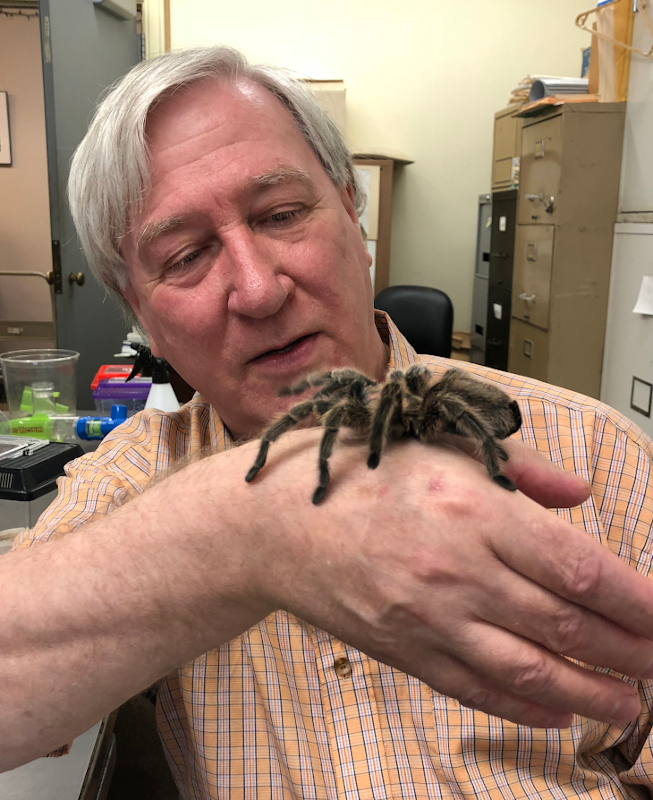
Dr. Boris Zakharov
Professor Boris Zakharov began his professional career in the “Kedrovaya Pad Natural Reserve” (Far East State University, Vladivostok, Russia) as a research scientist, where he participated in and performed various scientific projects in field zoology. Dr. Zakharov's Doctoral research was on horse flies (Diptera, Tabanidae), beginning in 1983 at Novosibirsk Biological Institute. The results of this study were published in his papers and concern systematics, ecology, biogeography and cattle protection from blood sucking diptera in Siberia.
After his arrival in the United States, Dr. Zakharov participated in a project on ground spiders of Australia and New Zealand in the American Museum of Natural History, where he has worked from 1996 to 2005 as a Curatorial Assistant in the Spider laboratory in a Department of Invertebrate Zoology. Currently, he occupies the position of a visiting scientist at the American Museum of Natural History, where he continues the study of ground spiders of the world.
Professor Boris Zakharov began to teach in 2005 at Hostos Community College/CUNY. Boris joined the Natural Sciences department at LaGuardia in 2009.
My dear reader, you probably are surprised or even intrigued by the title of this article. It would be too presumptuous of me to give you definitive answers to such questions. To tell you the truth, I do not plan to give a complete explanation of what life is, what death is, and whether it is possible for us individuals of species Homo sapiens become immortal one day. I’d rather invite you to think together about these concepts.
Interest in these subjects, is probably, as old as the existence of humanity itself. Thus, the Epic of Gilgamesh from ancient Mesopotamia, which dates back to the Third Dynasty of Ur (c. 2100 BCE), discusses possibility of human immortality. Another example can be found in stories on the Fountain of Youth, which tells about a spring that restores the youth of anyone who drinks or bathes in its waters. Tales of such a spring have existed around the world and have been mentioned in the writings of Herodotus (5th century BCE). Medieval legend of the Elixir of Life or Elixir of immortality that grants eternal youth to those who are lucky enough to drink it. Many alchemists all over the World spend their lives in search of this Elixir to stop aging and overcome death. Allegedly, Isaak Newton was also immersed in the search for the Elixir of immortality.
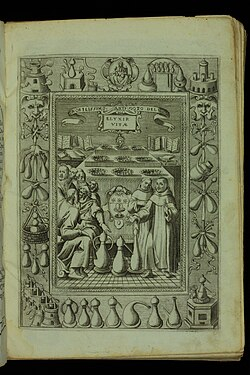
Dell' elixir vitae, 1624
Note that dreams of eternal youth and the ability to live forever are immanent to human mind. It is an indispensable element of human mentality. Our ancestors, like ourselves, were familiar only with different forms of life and had no such abstract ideas as non-material existence. Thus, for them, death is just a transition to a new form of existence, as a birth. In the depths of our minds, we inherited this worldview.
Incredible recent progress in medicine and technology has revived a new hope for eternal youth and immortality, not only the ideal immortality of our souls, but also in our physical bodies. This hope is reflected to some extent in the contemporary and somewhat ambiguous philosophy of Transhumanism. This movement suggests that current – and especially forthcoming – technologies could expand human biological abilities, increase well-being, and boost longevity, potentially leading to immortality (Kurzweil, 2024).
To initiate an examination of this subject, we will first define the concept of life and consider in what respects life may be regarded as eternal.
As with most natural sciences, “life” cannot be defined simply or precisely in a few words. We instinctively sense the distinction between living and non-living things. This difference is usually expressed in terms of specific properties that are present in living organisms, but absent or only partially present in non-living objects. One of the fundamental characteristics of Life is the ability to maintain different spatial physico-chemical gradients, such as the unequal distribution of molecules, electrical charges, or temperature. Existence of these gradients is a prerequisite to the existence of potential energy, which may be converted into other energy forms for the creation of new chemical bonds, movement, or the generation of nerve impulses. Thus, when non-living objects have a general tendency to develop towards thermodynamic equilibrium and equalization of all physico-chemical parameters, living organisms develop in the direction of an increase in these gradients. We can say that the evolution of Life is directed towards the increase of such kind gradients and, in general, to move further away from the stationary state of thermodynamic equilibrium.
At the same time, we know that living forms exist for relatively long periods of time. Let’s call these states of temporal stability – pseudo-equilibrium states, when destructive forces are temporarily equalized with integrity-maintaining forces. Thus, we can state that the evolution of Life directed from one state of pseudo-equilibrium to another in the direction away from thermodynamic equilibrium. Such a kind progression is accompanied by an increase in physical-chemical gradients and, as a result, an increase in the magnitudes of “vital” forces. Organisms become more active, metabolic reactions intensify, the flow of energy through the organism grows, and the rate of evolutionary development increases. As a result, evolution makes individual organisms less stable but enables groups of organisms to develop further and extend their collective lifespan as a unified whole.
Now we come to an interesting conclusion: Biological evolution is directed towards the elevation of structural complexity and the decrease of individual stability of living organisms, whereas social organization and longevity grow. Keep that in mind: let’s imagine what would happen if individual organisms became immortal? That means inevitable degradation of social organization. A society composed of immortal individuals falls apart. It also dramatically, if not completely, arrests the drive to biological evolution (in our case, it is the evolution of Homo sapiens).
Perhaps, with access to all scientific and technological achievements, humanity could find ways to overcome such obstacles?
At the beginning of the XX century, Russian Soviet scientist Vladimir Vernadsky proposed the Theory of Noogenesis or Evolution based on the power of reason. He advocated that humanity is at a pivotal point of its evolution. The growth of scientific knowledge and technological advantage makes humanity a global force that moves further the evolution of Life on Earth. As far as human activity is based on reason and free will, these human characteristics become driving forces of evolutionary process. Vernadsky proved that human activity has such a global effect on the Biosphere that, in the near future, the whole development of Earth with life on it will be controlled by human society. This shift marks the transition from biological evolution to a phase of evolution directed by human reasoning.
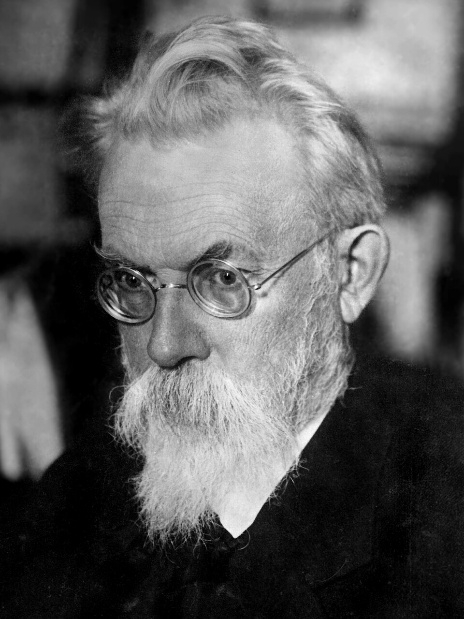
Vladimir Ivanovich Vernadsky in 1934.
This idea was later adapted by the French scientist Teilhard de Chardin in his idea about the Omega Point (see, for example, 2008). As a deeply religious person, Teilhard de Chardin interpreted this point as a transition to humanity’s unification with God.
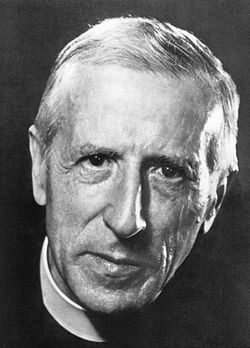
Pierre Teilhard de Chardin, 1 May 1881.
Humans are not entirely rational beings. Most of our actions are influenced not only by rational thought, but also by unconscious emotional beliefs. This influence of the unconscious mind results, for example, in our inability to achieve absolute certainty in scientific inquiry, making the pursuit of understanding nature an ongoing and infinite process. It is challenging to envision human society achieving full control over evolution through reason, especially when considering the instability of its current foundations.
On the other hand, what recent societal achievements could make people immortal? First: advances in biology and medicine. Second: advances in technology, particularly in the field of AI. Let’s look at them more closely.
We have already found that from a biological perspective, immortality will become a disaster. A society that consists of immortal individuals loses natural resources for evolution and may become defenseless when it runs into new obstacles it has never encountered before. The principal Evolutionary Law may be formulated as the “Red Queen Law”: “Well, in our country”, said Alice, still panting a little, “you’d generally get to somewhere else – if you ran very fast for a long time as we’ve been doing.” “A slow sort of country!” said the Queen. “Now, here, you see, it takes all the running you can do, to keep in the same place. If you want to get somewhere else, you must run at least twice as fast as that!” (see, for example, Carroll, 2005). Stagnation in evolutionary development will also result in a decrease in energy flow through the human population and degradation of its social organization, which is only maintained by the cumulative effect of each individual’s energy.
We all witness technology transforming modern life. The introduction of new technologies promises to make our life easier, healthier, more secure, and eternally prolong them indefinitely. Modern medicine can now identify and treat many diseases once thought incurable. Genomics and biomimetics may soon enable the correction of genetic diseases and the replacement of failed organs. There remains just one challenge: the human brain. Perhaps AI will eventually help solve this mystery. Now, let’s imagine all these problems are solved. We have reliable and effective tools to correct human genetic makeup; we can manufacture and replace all organs. What outcome can we expect? There is an ancient Paradox of bold man: If the man who has thousands of hairs on his head loses one hair, will he become bold? If he loses his second hair? If he loses his third hair? We can continue many times. Question arises: At what particular moment does this man become bold? Our person undergoes so many genetic corrections and transplant replacements that we can ask: Is this man the same as we knew him before? AI that supports our man in solving problems and taking decisions makes this question even more dramatic: Is this man a human? Personally, I am uncertain at this time. Thus, even though we overcome purely biological evolutionary obstacles, we see that such kind of immortal entity is no longer human. Yes, the evolutionary process may continue, but from this very moment, it will be evolution of other entities, and humans will be left behind. Will it be a Noogenesis or Evolution directed by the power of reason? I do not think so. AI created by humans from its origin carries uncertainties consciously or, which is more probable, unconsciously, inbuilt in AI algorithms, do not allow it to be a pure reason.
Now, let’s conclude, my dear reader. From an individual perspective, we have to pursue a long-lasting and healthy life. But immortality is not attainable. However, if it becomes a reality one day, that day will be the last day of humanity. It will be another “species” and another for of evolution, not human.
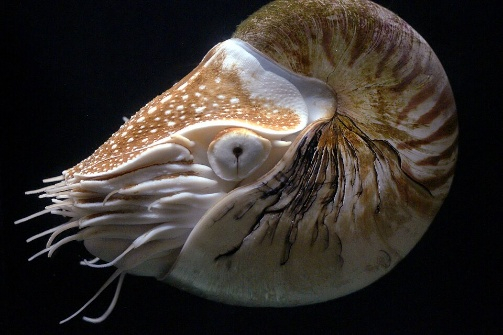
Nautilus pompilius Linneus, 1758. Nautilidae are among the most ancient animals encountered 500 million years ago. From: Wikimedia Commons
1. Kurzweil, R. (2024). The singularity is nearer: When we merge with AI. Penguin Books, 419 pp.
2. Vernadsky, V. I. (1997). The biosphere. Copernicus, New York, 192 pp.
3. Teilhard de Chardin, P. (1959). The phenomenon of man. Harper Perennial, 1976; reprint 2008.
4. Carroll, L. (2005). Through the looking-glass and what Alice found there. Barnes & Noble, New York.
.jpg)