
by Rebecca Elbogen, Jay Kim, and Adam Lafortune
This work was done by LaGuardia students - Rebecca Elbogen, Jay Kim, and Adam Lafortune as a part of the Honors “General Biology I” class, Fall 2025. The research was done under the supervision of Dr. Natalia Biani, from the Natural Sciences department of LaGuardia Community College.
 Rebecca Elbogen.
Rebecca Elbogen earned a B.A. in Developmental Psychology from New York University with research experience in language and social development. She is currently pursuing graduate studies in Occupational Therapy.
 Jay Kim.
Jay Kim is a writer and translator based in Queens, NY. After a lifelong love of arts and literature that culminated in getting a B.A. in Comparative Literature from Princeton University, she is now a pre-PT student with the aim of getting a doctorate in physical therapy.
 Adam Lafortune.
Adam Lafortune is interested in genomics and has conducted undergraduate research at LaGuardia Community College. He will pursue a B.S. in Biometry and Statistics at Cornell University.
Although most organisms have similar survival needs such as water and energy, the environments they live in can be drastically different. The purpose of this study was to compare populations in adjacent sub-environments, specifically the water and soil, of Little Neck Bay. Little Neck Bay is an estuary on the north shore of Long Island, New York, commonly used for recreational activities. DNA sequencing of microbes in samples of the sub-environments was used to identify populations for comparison. Parameters of the sub-environments such as pH and salinity were also measured. Results of the DNA sequencing led to the conclusion that bacteria are dominant across the sub-environments, but within soil there is greater bacterial and archaeal species richness. Meanwhile, the water sub-environment contains more eukaryotic species. Some species uniquely present in different samples were indicators of environmental parameters like nutrient availability. The results demonstrated that within the Little Neck Bay ecosystem, there exist bordering sub-environments with unique parameters, populations, and ecological activity.
With this project, our aim is to examine and compare the water and soil in Little Neck Bay using DNA sequences from organisms found in samples taken from adjacent zones. We hypothesize that the water sample and soil sample will display drastically different populations of little creatures. Although the two samples come from the same relative area and climate zone, the organisms we will find in each require specific conditions, such as a certain pH, temperature range, and nutrient availability, to thrive, causing them to choose the water and avoid the soil and vice versa (Sieber et al., 2020). Taking a closer look at the current organisms that exist in the water versus soil can signify what sorts of nutrients are available or lacking in each one of these environments.
Furthermore, we anticipate finding more species that are harmful to humans in the water sample than in the soil sample. Little Neck Bay is an estuary in New York City enjoyed by fishers, boaters, and other water recreationalists. These activities presuppose an environment that is clean and safe enough for humans. Ironically, a higher level of human activity will also impact how safe it can be for human activity (World Health Organization, n.d.). Some sources describe Little Neck Bay as one of the cleanest bays in the city while others warn of its pollution and sewage runoff (Guidesly, n.d.; Brady, 2022). Based on what is known about the organisms we find in the samples, we can deduce if the soil or water are sources of concern for human wellbeing and also consider how these organisms might further impact Little Neck Bay.
We hypothesize that not only will the microscopic biodiversity differ between the water and soil samples, but that the water sample will have a greater variety of species and/or more species that might be harmful to humans. We predict this difference based on the inherently dynamic nature of the estuary waters compared to a more stable underground environment.
Our approach was to obtain both a water and soil sample from the same location, then analyze the samples for their comparison . Our water sample was collected from Little Neck Bay on September 6th, 2025, at 2:00 PM. Our soil sample was also collected, at the same time, from the shore adjacent to where the water was sampled.
To find out what microscopic organisms were present in our samples, we isolated genomic DNA with the FastDNA™ SPIN Kit for Soil Fig. 1A and had an external lab analyze the DNA through PCR based metagenomic analysis.
To determine the amount of O2 in our water sample, we used the LaMotte oxygen titration kit (Fig. 1B). To determine the salinity of our sample, we evaporated a known volume of water, then weighed the solid residue remaining Fig. 1 C). For CO2, we used the LaMotte Carbon Dioxide kit and titration assay (Fig. 1D).
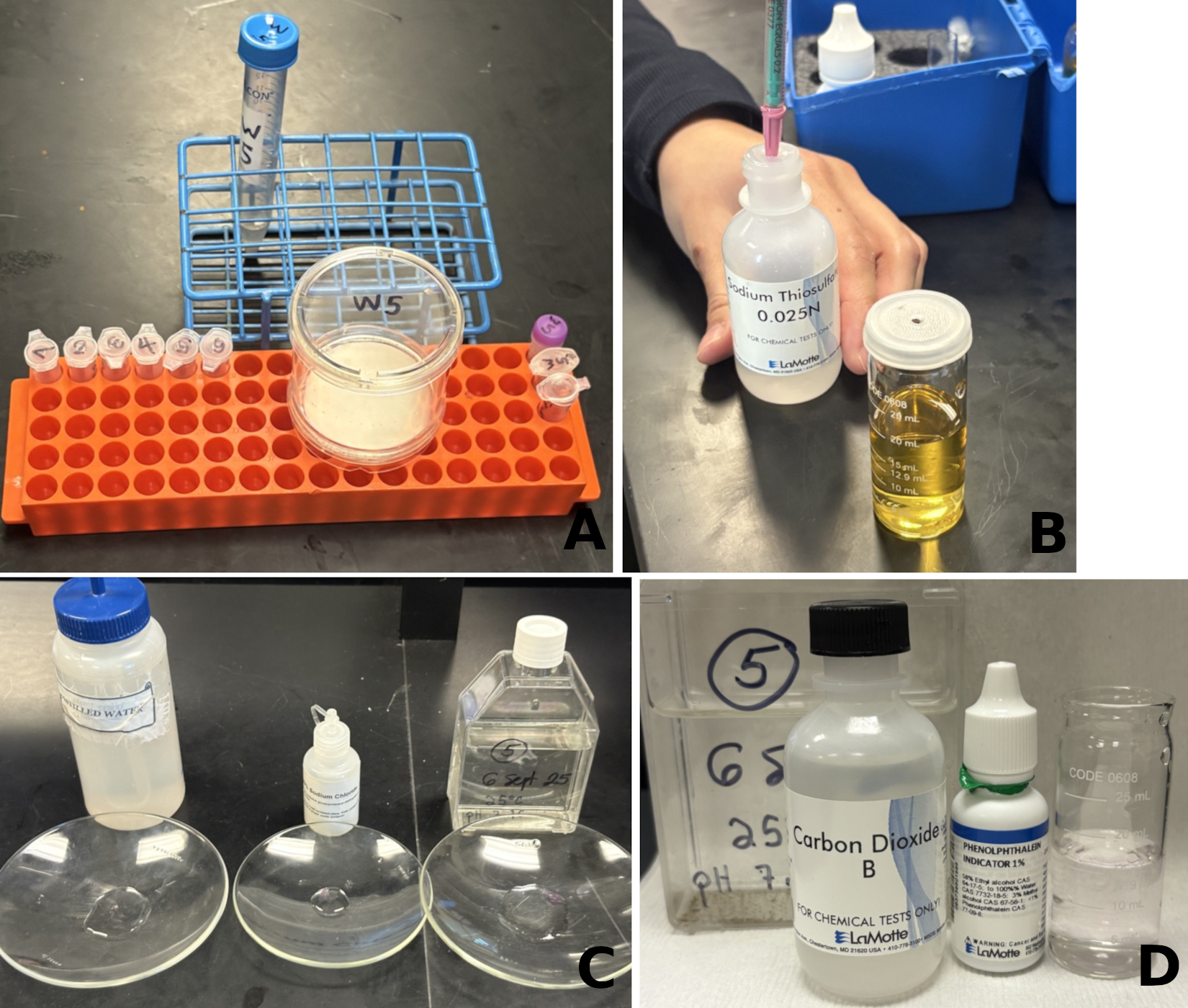
Figure 1: Photos of various methodologies used in the lab to A) purify DNA; B) measure dissolved oxygen; C) Salinity and D) carbon dioxide.
Overall, there was a significantly higher quantity of Bacteria compared to eukaryotes and Archaea in both the water and soil. The soil sample had more diversity of classes/species of Bacteria and Archaea compared to the water. The water sample had many more eukaryotes than the soil sample. The water sample had a temperature of 25°C, a pH of 7.75, dissolved oxygen was 4.7 ppm, carbon dioxide concentration was 18 mg/L, and salinity concentration of 30,000 mg/L.
Bacteria
The soil sample had a total count of 24,317 different bacteria species which is more than the water sample’s total count of 22,588 bacterial species (Figs. 2 and 3). Analysis of the most abundant bacteria classes showed that the water sample, when compared to the soil sample, had a greater total count of bacteria species in three of these classes: Chlamydiia (11 in water vs. 0 in soil), Cyanobacteria (727 vs. 210), and Cyanophyceae (311 vs. 3). Conversely, the soil sample had a larger total count of bacteria species, compared to the water sample, in four classes classes: Gammaproteobacteria (7,455 in soil vs. 5,557 in water), Epsilonproteobacteria (266 vs. 50), Clostridia (87 vs. 0), Mollicutes (18 vs. 13). If we narrow in on specific species, the most abundant bacteria in the water sample was Candidatus pelagibacter ubique (6,159 total count; 27.3% of all water species), followed by Pseudohongiella spirulinae (1,750 total count; 7.7% of species), and Planktomarina temperata (1,001 total count; 4.4% of species). These amounts were much higher than amounts found in the soil sample which – in the same order of species listed above – had total counts of 0, 107, and 2. Lastly, there was more Azotobacter salinestris found in water (421) compared to soil (0).
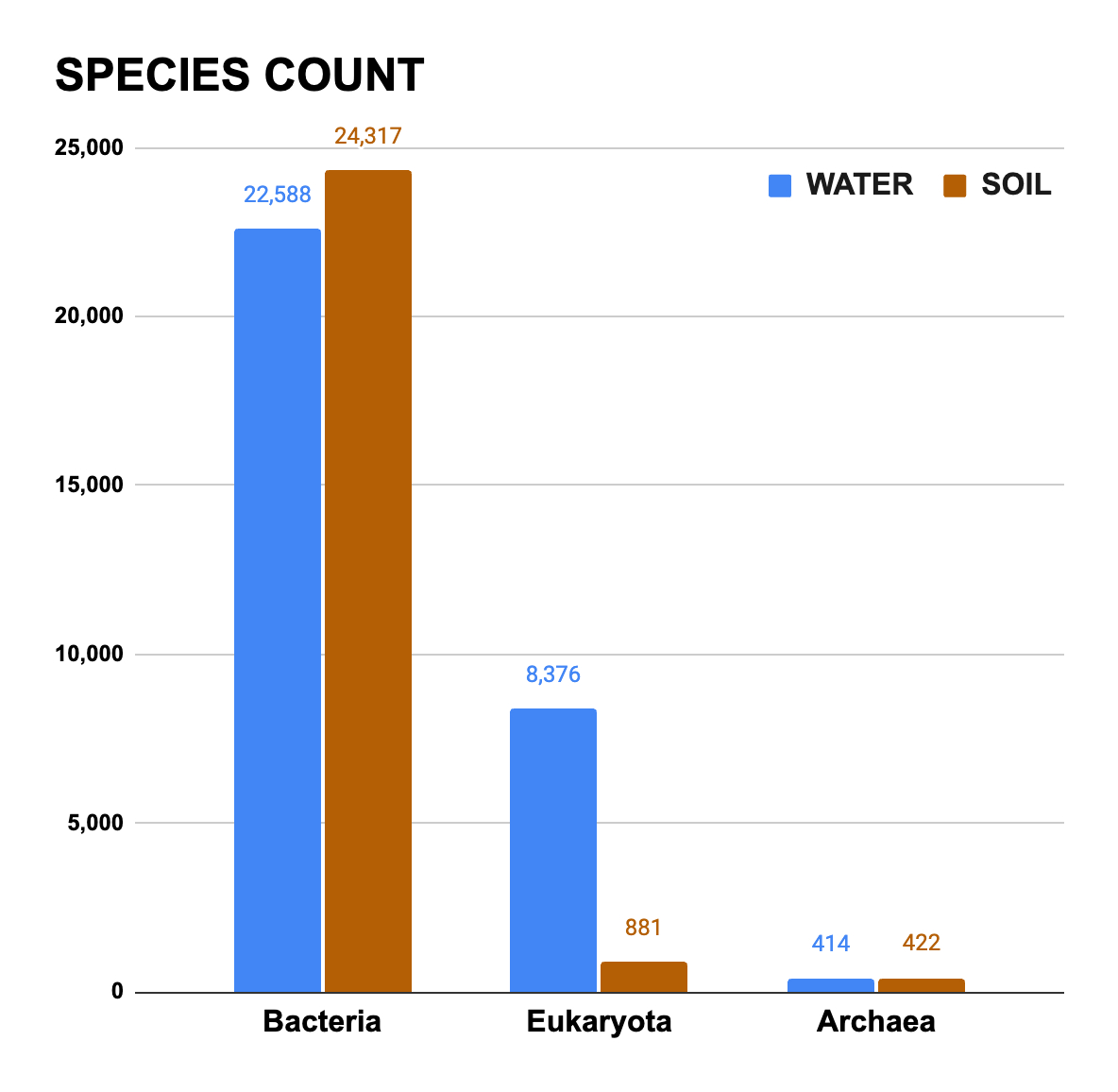
Figure 2: Difference in species count of bacteria, eukaryote, and archaea in water versus soil samples.
| Water | Soil | |
|---|---|---|
| Bacteria (Total Count) | 22,588 | 24,317 |
| Gammaproteobacteria | 5,557 | 7,455 |
| Epsilonproteobacteria | 50 | 266 |
| Clostridia | 0 | 87 |
| Mollicutes | 13 | 18 |
| Chlamydia | 11 | 0 |
| Cyanobacteria | 727 | 210 |
| Cyanophyceae | 311 | 3 |
| Eukaryotes (Total Count) | 8,376 | 881 |
| Dinophysis acuta | 10 | 0 |
| Navicula lanceolata | 15 | 247 |
| Thalassiosira eccentrica | 6514 | 200 |
| Rhizosolenia setigera | 126 | 0 |
| Archaea (Total Count) | 414 | 422 |
| Nitrosopumilus maritimus | 363 | 234 |
| Nitrosopumilus oxyclinae | 4 | 77 |
| Candidatus nitrosoarchaeum limnia | 47 | 49 |
| Nitrosoarchaeum koreensis | 0 | 45 |
| Methanosaeta pelagica | 0 | 17 |
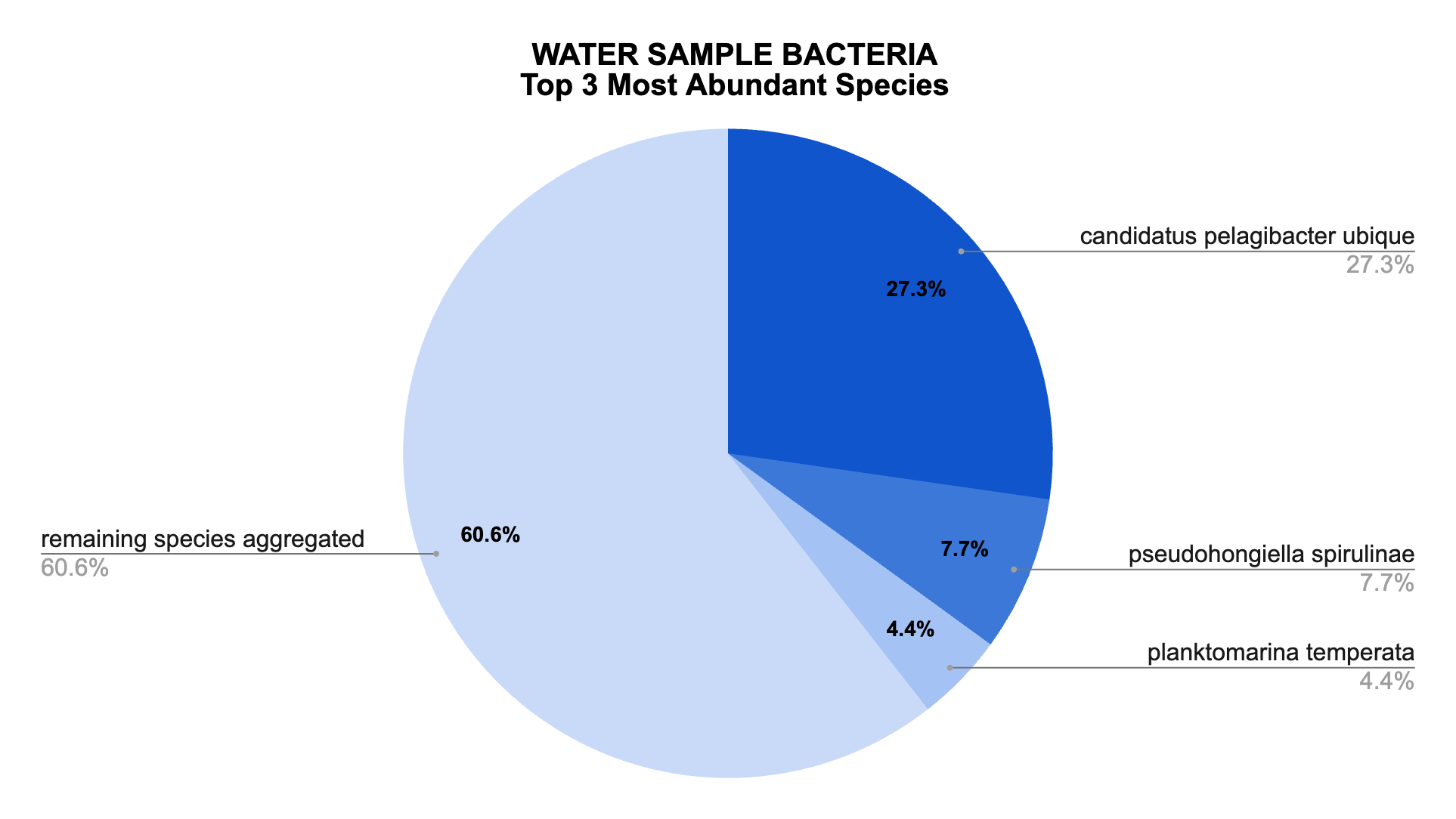
Figure 3: Percentage of bacteria species found in water sample. The three most abundant species are highlighted individually; each remaining species that made up less than 1% of the total count was aggregated.
| WATER SAMPLE: | |
|---|---|
| Temperature | 25°C |
| pH | 7 |
| Dissolved oxygen | 4.7 ppm |
| Carbon dioxide | 18 mg/L |
| Salinity | 30,000 mg/L |
Eukaryotes
The water sample had a total count of 8,376 species, which is much more than the soil sample’s total count of 881 species. Of the 4 eukaryotic species we highlighted, due to higher population counts or indication of environmental differences between the two sub-environments, the water sample had a larger count versus the soil sample of 3 species: Thalassiosira eccentrica (6,514 in water vs. 200 in soil), Rhizosolenia setigera (126 vs. 0), and Dinophysis acuta (10 vs. 0). Conversely, the soil sample had a larger total count versus the water sample of Navicula lanceolata (247 in soil vs. 15 in water).
Archaea
The soil sample had a count of 422 species, which is slightly more than the water sample’s count of 414 species. Of the 5 archaea species highlighted due to higher population counts, the water sample had a larger count versus the soil sample besides 1 species: Nitrosopumilus maritimus (363 in water vs. 234 in soil). Conversely, the soil sample had a larger count versus the water sample of 4 species: Nitrosopumilus oxyclinae (77 in soil vs. 4 in water), Candidatus Nitrosoarchaeum limnia (49 vs. 47), Nitrosoarchaeum koreensis (45 vs. 0), Methanosaeta pelagica (17 vs. 0).
The results confirm our hypothesis that the organisms in the water and soil are markedly different. However, there is insufficient evidence to state that the water or soil show signs of Little Neck Bay being a harmful environment to humans. The majority of the organisms we found are harmless to humans and are expected to be in this environment. For example, the most prevalent bacteria in the water sample, Candidatus pelagibacter ubique, is considered the most common organism in the world (Thiele, 2019). We did identify some organisms in the water and soil samples that are dangerous to humans. For instance, Dinophysis acuta causes shellfish poisoning (U.S. National Office for Harmful Algal Blooms, n.d.). However, the number was quite insignificant – only 10 out of 8,376 eukaryotes.
Another conclusion we can make from the number of each kind of organism we found in the sample is that as a whole, there is greater number of bacteria in the coastal soil of Little Neck Bay compared to its water; eukaryotes, on the other hand have a greater species abundance in the water when compared to soil. Archae species are equally abundant in both environments. Thus, our data allows us to come to these general conclusions about the domains, despite the huge diversity that we know exists in each one of these environments.
Interestingly, the soil sample had a slightly higher count of bacterial species (24,317) compared to the water sample (22,588). We initially hypothesized that the water would have a higher count due to the dynamic nature of this environment, especially given how frequently it is used by humans for various activities. However, the magnitude of difference in bacteria count between the samples is small compared to the difference in eukaryote species count: 8,376 in the water versus 881 in the soil. With that said, there could be confounding variables that influence the total count of microorganisms measured from a particular sample on a particular day: weather conditions, collection tools or methodology, biological testing process, etc.
It would be worthwhile to analyze the presence of certain species in different samples over time as a prognostic of ecosystem health. For instance, the algae and diatom Navicula lanceolata was the most abundant eukaryotic species found in the soil sample at 28% and can “serve as [an] important indicator of organic as well as anthropogenic pollution” (Singh & Parikh 2020). It is worth noting that the water sample only had a count of 15 Navicula lanceolata compared to the soil’s 247, which is somewhat surprising considering it is an algae. Comparing the distribution of this species in other samples from different locations or times could be a marker of the shifting impact of pollution.
Brady, R. (2022, November 3). Group highlights Little Neck Bay pollution. Queens Chronicle. https://www.qchron.com/editions/north/group-highlights-little-neck-bay-pollution/article_e76e66e9-8671-56cb-812d-3b21ca7aa853.html
Diarrhetic shellfish poisoning. U.S. National Office for Harmful Algal Blooms. (n.d.). https://hab.whoi.edu/impacts/impacts-human-health/human-health-diarrhetic-shellfish-poisoning/
Euler, A., & Freiberg, D. (n.d.). The History and Ecology of Little Neck Bay, LI, NY. National Fish and Wildlife Foundation. https://www.nfwf.org/sites/default/files/finalreports1/7460_2008-0065-004_Report_History_and_Ecology_of_Little_Neck_Bay.pdf
Giovannoni, S. J. (2017). SAR11 bacteria: The most abundant plankton in the oceans. Annual Review of Marine Science, 9(1), 231–255. https://doi.org/10.1146/annurev-marine-010814-015934
Guidesly. (n.d.). Little Neck Bay, New York: Guidesly. https://guidesly.com/fishing/waterbodies/Little-Neck-Bay-New-York
OpenAI. (2025). ChatGPT 4.5. https://chatgpt.com/share/693830f8-8a44-8010-b5c0-13363df45646
Sieber, G., Beisser, D., Bock, C., & Boenigk, J. (2020). Protistan and fungal diversity in soils and freshwater lakes are substantially different. Scientific Reports, 10(1). https://doi.org/10.1038/s41598-020-77045-7
Singh, M., & Parikh, P. (2020). Freshwater diatoms as bio-indicators in urban wetlands of Central Gujarat. Indian Journal of Ecology, 47, 7–11. https://doi.org/10.5281/zenodo.3961445
Thiele, K. (2019, May 31). The most ubiquitous and abundant species on Earth. Taxonomy Australia. https://www.taxonomyaustralia.org.au/post/the-most-ubiquitous-and-abundant-species-on-earth
Wang, G., Fan, J., Wu, H., Zhang, X., Li, G., Zhang, H., Yang, X., Ye, F., Xiang, W., & Li, X. (2013). Nonhongiella spirulinensis gen. nov., sp. nov., a bacterium isolated from a cultivation pond of Spirulina platensis in Sanya, China. Antonie van Leeuwenhoek, 104(6), 933–939. https://doi.org/10.1007/s10482-013-0012-4
World Health Organization. (n.d.). Recreational waters. World Health Organization. https://www.who.int/teams/environment-climate-change-and-health/water-sanitation-and-health/water-safety-and-quality/recreational-waters
Walker, C. B., et al. (2010). Nitrosopumilus maritimus genome reveals unique mechanisms for nitrification and autotrophy in globally distributed marine Crenarchaea. PNAS, 107, 1–6. https://doi.org/10.1073/pnas.0913533107